AI vs. Automation: What's the Difference?
People throw both words around like they mean the same thing. They don't. And knowing the difference will save you a lot of confusion — and probably some money.
Let's use your kitchen to explain this.
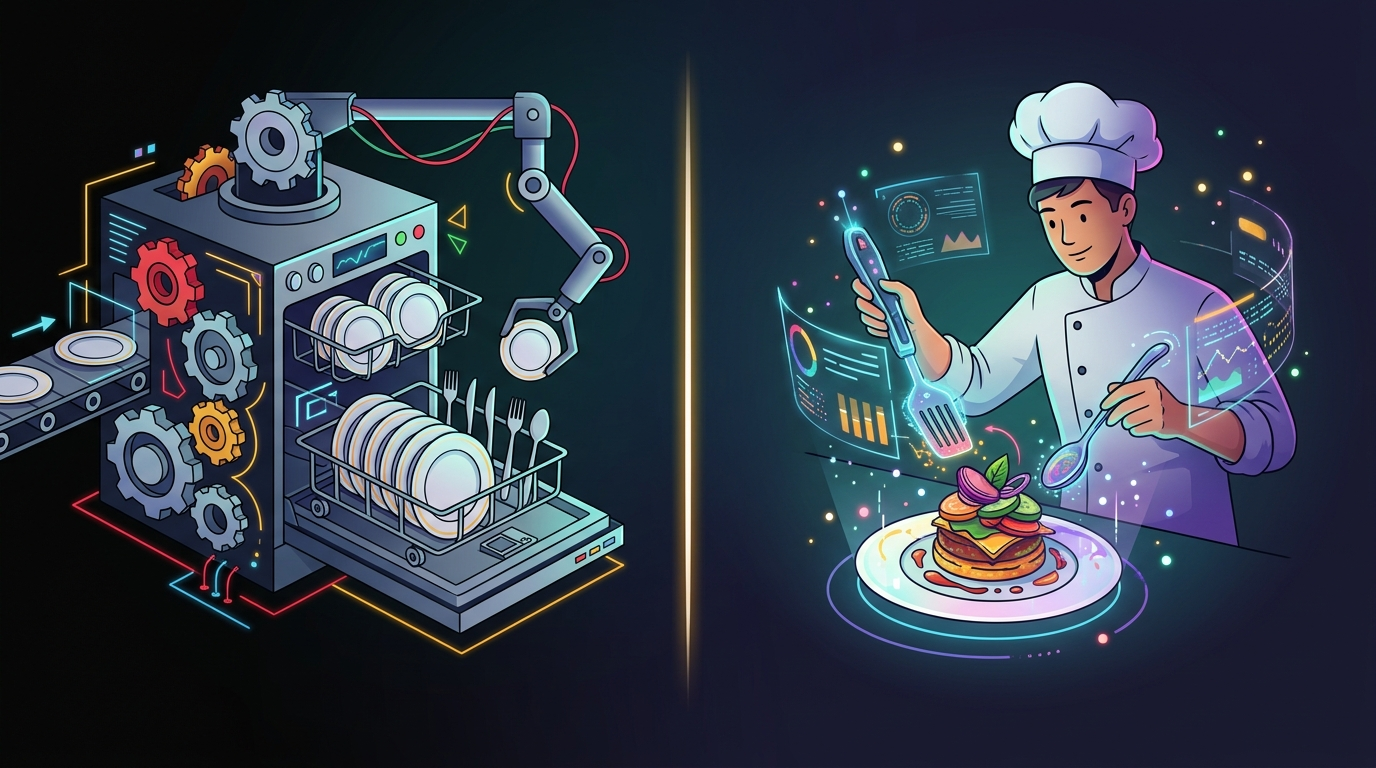
Your Dishwasher vs. Your Chef
Your dishwasher is automation. You load it, hit start, and it runs the exact same cycle every single time. Hot water, detergent, rinse, dry. It doesn't care what's in there. It doesn't adjust if you put in a delicate wine glass. It follows its program — and that's it.
Now imagine a chef. You walk into her kitchen and say "I'm really tired and kind of sad, can you make me something comforting?" She looks at what's in the fridge, thinks about what you might like, and makes a decision. She used judgment.
That's the difference.
Automation is your dishwasher. It executes the same steps, in the same order, every time. Clear rules, predictable results.
AI is the chef. It takes in messy, unpredictable input and figures out what to do with it — because it's seen a lot of similar situations before and learned how to handle them.
Automation in Real Life
Automation is everywhere, and it's incredibly useful. It just follows rules someone wrote in advance.
Examples you encounter all the time:
- Your thermostat turns the heat on when the temperature drops below 68 degrees
- Your bank sends you a text every time a purchase over $500 hits your account
- A website sends a welcome email the moment someone signs up
- Traffic lights cycle through green, yellow, red on a timer
None of these require judgment. Someone figured out the rules, programmed them in, and now the system runs them perfectly and repeatably forever.
That's the superpower of automation: it never gets tired, never forgets, and never does it differently. The limitation: it only handles exactly what it was programmed for. Throw something unexpected at it and it either breaks or ignores it.
AI in Real Life
AI kicks in when the situation is too unpredictable to write rules for.
- A customer sends an angry email — but their complaint is unusual and doesn't fit any standard template. AI reads it, understands the tone, and drafts a response.
- You tell Netflix you're in the mood for something funny but not stupid. Netflix picks something that fits your specific taste, not just "popular comedies."
- You upload a photo of a rash and an app gives you possible explanations — because it's been trained on thousands of similar photos, not because someone wrote a rule for every possible rash.
The thing these all share: there's no clean rule to follow. The input is messy. The right answer depends on context. You need something that can exercise judgment rather than just execute instructions.
Sort These Out
Let's see if you've got the feel for this.
Sort each task into 'Automation' or 'AI'
Send a birthday discount email every year on a customer's birthday
Read a customer complaint and figure out if they're upset, confused, or just asking a question
Move every PDF attachment in your email to a specific folder
Suggest which of your photos would make the best profile picture
Charge a customer's credit card on the first of every month
Listen to a voicemail and summarize what the caller wanted
Why This Matters to You
Here's the practical reason to care about this distinction:
If you need something done the same way every single time — use automation. It's cheaper, faster, and more reliable for rule-based stuff.
If you need something to handle variety, language, or judgment — that's where AI earns its keep.
A lot of businesses overpay for AI when simple automation would do the job. And a lot of businesses under-use AI on the messy stuff that's genuinely hard to write rules for.
Knowing the difference puts you ahead of most people making decisions about these tools.
Quick Check
Quick Check
5 questions · Earn points for speed!
🔀 Random selection — different questions each play!
Key Takeaway
Automation is a light switch — it does one thing, perfectly, every time. AI is a judgment call. Most good systems use both: automation for the predictable stuff, AI for everything else.
Ready to complete this lesson?
You've reached the end! Hit the button below to earn your XP.