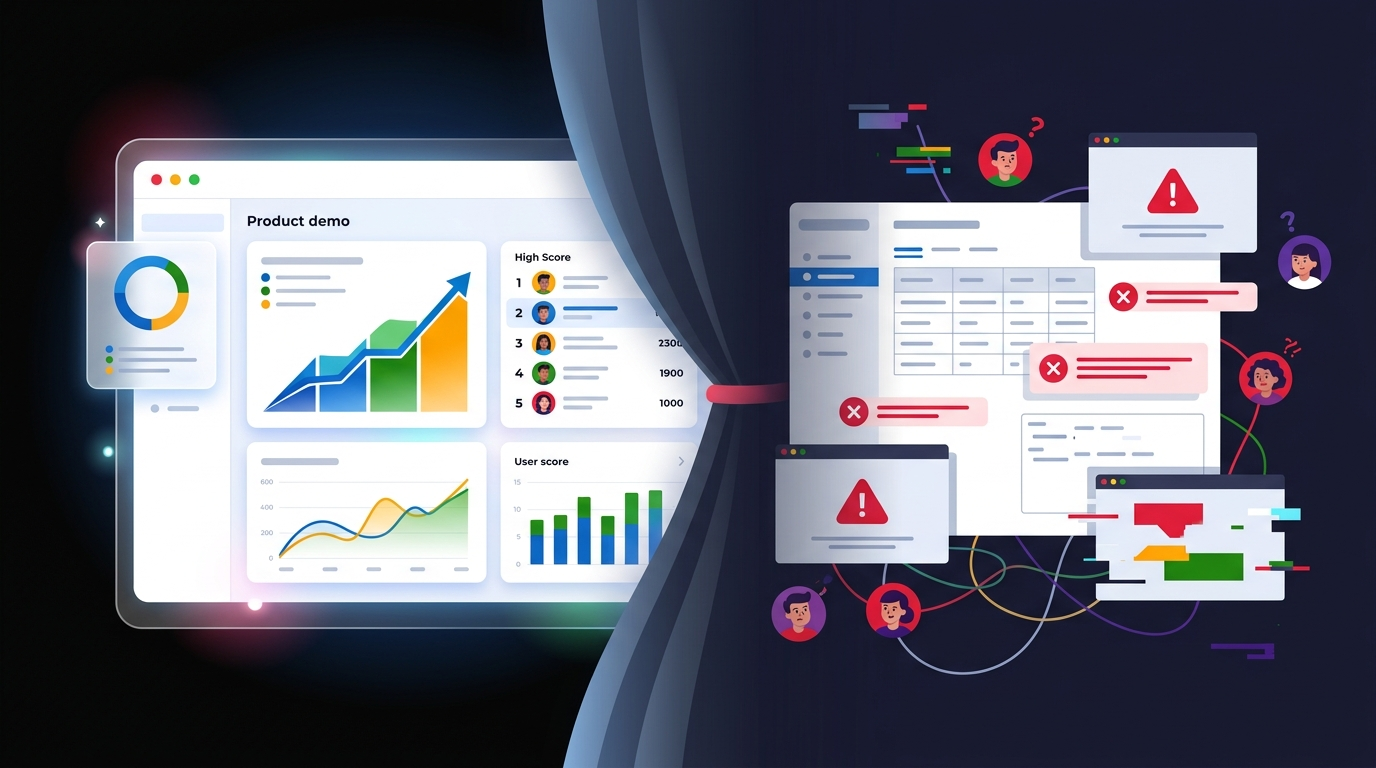
AI sales demos are some of the most polished in tech right now. The tools look amazing. The use cases are compelling. The ROI claims are astronomical.
Most of it is real — in the best-case scenario, with perfect inputs, and a dedicated implementation team.
Here's how to decode what you're actually being sold.
Why AI Pitches Are Different
With most software, demos represent the real product. With AI, demos often represent the ceiling — the best possible outcome under ideal conditions.
The gap between demo and reality in AI is wider than in almost any other software category. This isn't necessarily dishonesty; it's a structural feature of probabilistic systems. But it means you need to do more due diligence, not less.
The 8 Classic Red Flags
?1. 'Our AI is 99.9% accurate'
Tap to reveal→
✓1. 'Our AI is 99.9% accurate'
All LLM-based AI hallucinates. All of it. A system that claims 99.9% accuracy either has a very narrow, well-defined task (where you could just write rules), is cherry-picking the metrics they're measuring, or is simply lying. Ask: accurate on what dataset? Measured how? Validated by whom? If they can't show you third-party validation, treat this as noise.
← Tap to flip back
?2. 'It learns from your data automatically'
Tap to reveal→
✓2. 'It learns from your data automatically'
Most hosted AI tools don't retrain on your data in real time. What they usually mean is: the context window accumulates conversation history, or there's a RAG (retrieval-augmented generation) layer that pulls from your documents. That's not 'learning' in the machine learning sense. It's memory management. Ask exactly how personalization works — is it fine-tuning, RAG, prompt context, or just a feedback button that goes nowhere?
← Tap to flip back
?3. 'We integrate with everything'
Tap to reveal→
✓3. 'We integrate with everything'
'Everything' usually means: the 20 most popular tools via their APIs, with varying levels of depth. Ask for the specific integration you need, tested live in the demo. Ask what the fallback is if an integration breaks. 'Native integration' often means a one-way Zapier connection with no error handling.
← Tap to flip back
?4. 'ROI guarantee — 10x your output in 30 days'
Tap to reveal→
✓4. 'ROI guarantee — 10x your output in 30 days'
ROI claims in AI pitches are almost always based on best-case scenarios from customer stories carefully selected for the sales deck. Ask: what does the ROI model actually assume? What does onboarding look like — how long before the tool is actually running? What's the average time-to-value across all customers, not just the top case studies?
← Tap to flip back
?5. 'No technical setup required — works out of the box'
Tap to reveal→
✓5. 'No technical setup required — works out of the box'
There is almost always setup required for any AI tool to be actually useful to a specific business. Training it on your products, connecting it to your data, configuring workflows, setting guardrails, testing edge cases. 'No setup' means no setup for a generic demo. For your actual use case: plan for at least 1-4 weeks of configuration. Ask what a typical onboarding looks like, step by step.
← Tap to flip back
?6. 'Our AI understands your industry'
Tap to reveal→
✓6. 'Our AI understands your industry'
Most AI tools are general-purpose LLMs with industry-specific prompts and a curated knowledge base. That's useful — but it's not the same as a model trained from scratch on healthcare, legal, or financial data. Ask: what data was the model actually trained on? Is there a human review process for domain-specific outputs? What happens when the AI gives wrong industry-specific advice?
← Tap to flip back
?7. 'We're the only platform that can do this'
Tap to reveal→
✓7. 'We're the only platform that can do this'
The AI tool space moves at extraordinary speed. If a vendor claims exclusive capability, either they have a meaningful technical moat (rare but real) or they're exaggerating competitive differentiation. Ask: what specifically does your platform do that competitors can't? Is that a patent, a proprietary model, or a feature gap that could close in 6 months?
← Tap to flip back
?8. 'The demo runs on your actual data'
Tap to reveal→
✓8. 'The demo runs on your actual data'
Sometimes true, often not. Many demos use carefully prepared 'sample' data that showcases the model's strengths and avoids its weaknesses. Ask to see the tool run on your actual messy, real-world data — not cleaned samples. The gap between curated demo data and your real data is often where the product falls apart.
← Tap to flip back
The Demo Manipulation Playbook
Sales demos are designed to highlight strengths and avoid weaknesses. Watch for:
The single-path walkthrough — they show you one perfect scenario. Ask what happens with edge cases, bad inputs, or ambiguous requests.
The live demo that's actually pre-recorded or staged — if the demo feels too smooth, ask to try a specific prompt yourself in real time.
The feature that's "coming soon" — if you're buying based on a roadmap promise, that's a bet on execution. Get it in writing with a timeline and refund terms, or wait.
The impressive output that takes 20 minutes of back-and-forth to produce — if the AI needs extensive prompting to generate something good, factor that prompting effort into your actual workload.
Sort the Signals
◆
Sort It Out
Sort these vendor claims and behaviors into Red Flags and Green Flags.
◆Red Flag
●Green Flag
"Our AI hallucinates about 2-3% of the time on this task — here's how we handle that"
"We guarantee 10x ROI in 30 days or your money back"
"Here's what onboarding looks like step by step — it usually takes 2-3 weeks to get fully configured"
"Our AI learns your business automatically — no setup needed"
"Let me run your actual data through it right now so you can see how it handles your real inputs"
"We integrate with everything"
"Here are three customers who tried it and it didn't work well for their use case — and here's why"
"This feature is on our roadmap for Q3 — we're confident it'll be ready by then"
Quick Check
▲
◆
●
■
Quick Check
5 questions · Earn points for speed!
🔀 Random selection — different questions each play!
▲
◆
●
■
Key Takeaway
The best thing a vendor can do in a pitch is tell you honestly what their tool doesn't do well. Vendors who acknowledge limitations are selling you a real product. Vendors who can't find any limitations are selling you a story.
🎓
Ready to complete this lesson?
You've reached the end! Hit the button below to earn your XP.